

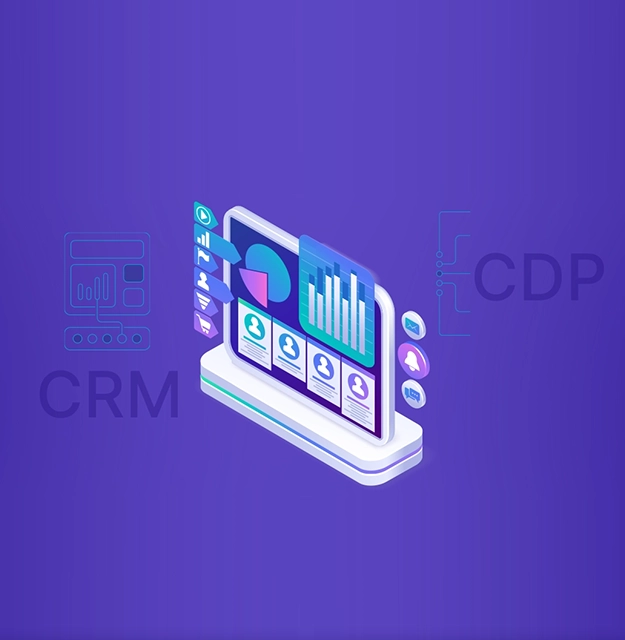
Industrial sales used to be straightforward, a few trade fairs and a handful of distributors. Long-standing relationships sealed with handshakes and technical datasheets. Not anymore, today’s industrial customer journey is digital, fragmented and… surprisingly emotional. Engineers download whitepapers at midnight, procurement teams compare suppliers across five tabs. CEOs ask for ROI projections before the first meeting even happens and suddenly, your traditional CRM and CDP conversation becomes unavoidable.
If you’re serious about industrial sales digital transformation, you can’t rely on intuition alone, you need unified customer data B2B, you need visibility across touchpoints, you need CRM CDP synergy. So the real question isn’t “Do we need better tools?”
It’s: Are we ready for a true data revolution in industrial sales?
73% of B2B buyers expect personalized experiences
This global report is based on thousands of B2B and B2C respondents. The statistic about customers expecting companies to understand their unique needs and expectations appears in recent editions (2022–2023).
Companies using advanced Data integration are 2.6x more likely to exceed revenue goals
McKinsey research consistently shows that organizations leveraging advanced analytics and integrated customer data significantly outperform peers in revenue growth and profitability. The exact multiplier can vary depending on the study edition.
B2B buying involves an average of 6 to 10 decision-makers
Gartner frequently cites that a typical B2B buying group includes 6 to 10 stakeholders, each armed with independent information gathered digitally.
Organizations with strong omnichannel engagement retain 89% of their customers
Aberdeen’s comparative research highlights that companies with strong omnichannel customer engagement strategies achieve significantly higher retention rates than those without.
Understanding CRM and CDP in industrial context
Before we talk strategy, we need clarity. CRM and CDP integration sounds technical… maybe even abstract but in reality, it’s about something very simple: understanding your industrial customers in a coherent way.
Let’s break it down.
What is CRM in B2B and industrial sales?
A CRM (Customer Relationship Management system) is the backbone of most industrial CRM strategy initiatives.
It tracks:
- Leads and opportunities
- Sales activities
- Quotes and contracts
- Account history
- Revenue forecasts
In B2B and industrial sales, CRM systems are indispensable, sales cycles are long deals involve multiple stakeholders and technical specs evolve without CRM, it’s chaos.
But here’s the nuance… CRM captures declared and transactional data, it records what sales teams input. It reflects structured interactions.
What it often misses? Behavioral signals, digital engagement, anonymous browsing patterns, pre-sales research behavior.
And that gap matters.
What is a CDP and why it matters in industry?
A Customer Data Platform industrial solution does something different.
A CDP centralizes data from:
- Website visits
- Marketing automation platforms
- Email campaigns
- IoT signals
- Service systems
- ERP data
- Partner channels
It builds persistent profiles based on B2B omnichannel data not just what customers say but what they do.
In industrial markets, this is powerful, imagine knowing that a manufacturing client has visited your spare parts page five times before contacting sales or that a distributor in a specific region is browsing new product lines.
That’s CDP for B2B marketing in action.
CRM vs CDP: differences, roles and complementarity
So… CRM vs CDP? It’s not a competition, it’s a partnership.
- CRM manages relationships and pipeline execution.
- CDP manages data unification and behavioral intelligence.
- CRM answers: What is the status of this deal?
- CDP answers: What is this account really interested in?
When combining CRM and CDP, you connect operational execution with deep customer insight.
That’s where the magic begins.
The complexity of industrial sales cycles
Industrial sales are not e-commerce checkouts; they’re marathons, sometimes triathlons and complexity changes everything.
Long buying journeys and multiple stakeholders
An industrial customer journey can last 6, 12, even 24 months.
During that time:
- Engineers evaluate technical specs
- Operations assess compatibility
- Finance calculates ROI
- Procurement negotiates contracts
- Management approves budgets
Each stakeholder leaves digital traces, each interacts differently without unified customer data B2B, you see fragments. With CRM CDP synergy, you see the ecosystem.
Fragmented data and siloed teams
- Marketing uses automation tools.
- Sales uses CRM.
- Service uses another platform.
- Distributors work in separate systems.
Sound familiar?
This fragmentation slows industrial sales digital transformation; decisions rely on incomplete data, opportunities slip through cracks… quietly.
Combining CRM and CDP creates continuity, marketing insights feed sales action, service data informs upsell opportunities.
Suddenly, teams stop guessing.
Technical, financial and operational decision layers
Industrial buyers are rational at least on paper but real decisions blend technical validation, financial modeling and operational feasibility a CDP helps you understand which layer matters most to each account at a given moment.
- Are they researching technical documentation?
- Are they downloading ROI case studies?
- Are they engaging with service-level agreements?
That behavioral intelligence transforms how sales prioritizes outreach.
Newsletter
Subscribe to our newsletter for the latest digital insights, tips, and news.
Why combining CRM and CDP creates competitive advantage
Let’s be honest, data alone isn’t a competitive advantage, but integrated, actionable data? That’s different.
Unified customer view across the entire funnel
A CRM and CDP integration enables a single source of truth.
From first anonymous website visit…
To marketing engagement…
To opportunity creation…
To post-sale service interaction…
This unified customer data B2B approach reduces blind spots; sales reps enter meetings informed and marketing campaigns align with real account interests.
And customers feel understood, not chased.
Advanced personalization for industrial buyers
Personalization in industry doesn’t mean flashy banners.
It means relevance.
Different content for engineering vs finance.
Different offers for OEM vs distributor.
Different timing based on buying stage.
CDP for B2B marketing enables segmentation based on behavior, not just firmographics.
And when CRM captures those insights directly in account records? Sales conversations become sharper, more contextual and more credible.
Data-driven sales forecasting and pipeline optimization
Traditional forecasts rely heavily on salesperson intuition.
But what if pipeline health also incorporated:
- Engagement intensity
- Website activity
- Product interest trends
- Service ticket patterns
That’s data-driven industrial sales.
With CRM CDP synergy, forecasting becomes dynamic, pipeline prioritization becomes evidence-based, risk detection becomes proactive and in competitive tenders, that edge matters.
How CRM + CDP improves each stage of the industrial sales cycle
From first anonymous visit to post-sale service renewal, every stage of the industrial sales cycle generates data. The question isn’t whether data exists it’s whether your systems connect it. CRM and CDP integration ensures that no opportunity, signal, or risk remains hidden.
Lead generation and qualification
CDP identifies high-intent accounts through behavioral scoring.
CRM captures and distributes these leads to the right sales teams.
The result? Fewer cold calls, more strategic outreach.
Account-based marketing (ABM)
Industrial sales often focus on key accounts, with B2B omnichannel data, marketing can orchestrate highly targeted ABM campaigns. Meanwhile, CRM ensures sales tracks engagement and follows up precisely.
It feels coordinated… because it is.
Sales enablement and opportunity management
Imagine a sales rep opening CRM and seeing:
- Recent whitepaper downloads
- Webinar participation
- Product page visits
- Service history
No more generic pitches.
CRM and CDP integration fuels contextual conversations.
Customer retention and upsell
Industrial revenue often depends on long-term service contracts and spare parts, CDP detects usage patterns and interest signals, CRM triggers upsell workflows.
Retention becomes proactive, not reactive.
Practical use cases in manufacturing and industrial sectors
Theory is interesting. Application is decisive. In manufacturing and industrial environments, CRM and CDP integration isn’t abstract; it directly impacts maintenance planning, distributor performance, cross-selling strategies and long-term contract profitability.
Predictive maintenance and service upsell
IoT data indicates equipment stress.
CDP aggregates usage data.
CRM alerts account managers.
You don’t just sell parts; you offer preventive solutions at the right time.
Distributor and partner channel optimization
Customer data platform industrial tools can aggregate performance across partner networks.
Which distributors convert best?
Which regions show emerging demand?
CRM operationalizes those insights.
Cross-sell and product recommendation engines
Behavioral data identifies complementary product interest, combining CRM and CDP allows tailored cross-sell suggestions within active opportunities.
It feels less like upselling… and more like problem-solving.
Implementation strategy – how to successfully combine CRM and CDP
Technology integration is only half the battle. True industrial sales digital transformation requires architectural clarity, governance discipline and organizational alignment. Without structure, even the best tools create noise instead of value.
Data architecture and integration planning
Start with mapping data flows.
Where does data originate?
How is it structured?
Which identifiers connect accounts across systems?
CRM and CDP integration requires clean architecture. Otherwise, you amplify chaos.
Governance, security and compliance
Industrial data is sensitive, contracts, technical designs and pricing.
Clear governance frameworks ensure data accuracy and compliance
Trust, internally and externally, depends on it.
Organizational alignment and change management
This might be the hardest part.
Sales must trust marketing data.
Marketing must understand sales workflows.
IT must facilitate integration.
Industrial sales digital transformation is cultural before it’s technical.
And culture shifts slowly… but deliberately.
Conclusion
Industrial markets are evolving, quietly, relentlessly.
The companies that win won’t just have bigger sales teams. They’ll have smarter systems, integrated intelligence, a deep understanding of their industrial customer journey.
Combining CRM and CDP is not about adding another tool, it’s about connecting the dots across B2B omnichannel data it’s about building unified customer data B2B environments that empower data-driven industrial sales.
In complex, multi-layered buying cycles, visibility is power.
And the real competitive advantage?
It’s knowing your customer better than anyone else… and acting on it.
Commonly asked questions FAQ
1.Is integrating a CRM with a CDP really feasible for complex industrial operations?
Absolutely. Modern platforms are designed forinteroperability and many industrial companies have successfully implemented CRM CDP integration without disrupting ongoing operations. A phased approach with clear data mapping ensures minimal risk and maximum adoption.
2.Will combining CRM and CDP justify the investment in terms of ROI?
Yes. By enabling unified customer insights, predictive sales forecasting and personalized engagement, companies often see faster pipeline conversion, higher dealvalue and better customer retention. In many industrial cases, ROI is visible within 6–12 months.
3.How can my team adapt to new workflows without losing efficiency?
Change management is critical. Start with pilot programs, provide real-time dashboards, and train staff on actionable insights rather than raw data. Teams quickly realize that CRM + CDPsynergy makes their work easier, not more complicated.
4.What if our existing systems are outdated or fragmented?
Integrationdoesn’t mean replacing everything. Even legacy CRM or marketing tools can feed into a CDP to create a unified view. The key is to identify data silos, establish connectors and prioritize high-impact accounts first gradual integration works best in industrial environments.
Newsletter
Subscribe to our newsletter for the latest digital insights, tips, and news.