

Industrial companies rarely suffer from a lack of knowledge, quite the opposite. Years of engineering experience are buried inside maintenance manuals, standard operating procedures, quality reports, ERP records, supplier contracts, tenders, emails, spreadsheets and databases. The knowledge exists… finding the right piece at the right moment is another story. This is where many conversations around generative AI in manufacturing become interesting. General-purpose AI models can reason across language remarkably well, but they do not automatically understand your equipment history, internal procedures, proprietary specifications or contractual obligations. Connecting them directly to sensitive industrial information can also introduce confidentiality, privacy and governance concerns.
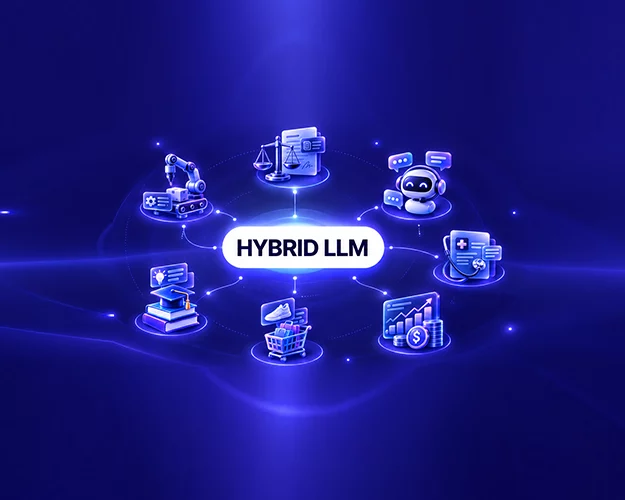
A Hybrid LLM offers another route: combine advanced language-model capabilities with controlled access to internal knowledge and appropriate security mechanisms. Retrieval-based architectures, for example, can provide models with current proprietary information without requiring that information to become part of the model’s original training data. The question, then, becomes less “Where can we put AI?” and more useful: Which workloads actually deserve it? Here are seven industrial LLM use cases where the answer may be surprisingly concrete.
24% Generative AI is gaining ground in manufacturing
Nearly one in four manufacturers surveyed by Deloitte had deployed generative AI at the facility or network level in 2025. Another 38% were piloting it, highlighting the industry's ongoing transition from experimentation to implementation.
~70% Data quality remains a major barrier
Nearly 70% of manufacturers surveyed cited data-related issues, including quality, contextualization and validation, as significant obstacles to AI implementation. Reliable, well-structured information is a critical foundation for useful industrial AI.
97% AI adoption must go hand in hand with security
Among organizations reporting breaches involving AI models or applications, 97% lacked appropriate AI access controls. This highlights why permissions, data protection and governance must be built into enterprise AI architectures.
What makes a workload suitable for a Hybrid LLM?
Not every repetitive process needs generative AI, sometimes a rule is simply a rule. The interesting territory begins when employees have to read, interpret, connect and explain information before they can act.
A strong Hybrid LLM workload usually sits somewhere between information retrieval and human judgment.
Think about an engineer searching through six manuals, two previous incident reports and an internal portal to answer one operational question, or a bid manager reading a 180-page tender to identify deadlines, technical obligations and missing certificates. These tasks aren’t difficult because people lack expertise, they’re difficult because the relevant context is scattered.
Several characteristics make a workload particularly interesting for Hybrid LLM deployment: large volumes of documents, repetitive searching or summarization, specialized terminology, proprietary information, disconnected sources and a requirement for traceable answers.
Traceability matters, retrieval-augmented systems can connect generated answers to source material, allowing employees to verify information instead of simply trusting a fluent response.
There should also be a clear place for human validation and a measurable baseline: processing time, error rates, escalation rates, downtime or expert hours.
What about a fixed calculation or a deterministic workflow?
Keep it deterministic, if a traditional automation rule can reliably solve a problem, introducing an LLM may simply add complexity. Enterprise AI use cases become compelling when language, ambiguity, fragmented knowledge and contextual reasoning are genuinely part of the workload.
1.Technical knowledge and SOP assistant
Your company may already have the answer. The problem? Nobody knows exactly which document contains it or which version is still valid.
The business problem
Industrial knowledge accumulates slowly and spreads quickly.
A machine manual lives in one repository, an updated procedure sits on an internal portal, a specification exists as a PDF, a veteran engineer remembers an exception that was documented three years ago in a technical report.
Now imagine an employee asking:
“What is the approved shutdown procedure for this machine model?”
The traditional workflow may involve keyword searches, folder navigation and manual comparison between documents. Add multiple facilities, languages and equipment generations, and even a seemingly simple question becomes expensive.
How a Hybrid LLM helps
A Hybrid LLM can provide a natural-language interface to an authorized internal knowledge base.
Instead of asking employees to understand where information is stored, the system can retrieve relevant passages from approved documents, synthesize them and present an answer alongside references to the original material.
This distinction is important, the goal isn’t to make the model sound knowledgeable, it is to ground the answer in company knowledge.
A hybrid architecture can also help organizations control how proprietary information is processed. NECTOS, Eminence Industry’s hybrid AI architecture, combines local processing, anonymization and masking of sensitive information before external generation, followed by local reintegration within the organization’s governed environment.
The resulting assistant becomes less like a generic chatbot and more like a conversational doorway into industrial knowledge.
2.Maintenance and troubleshooting copilot
When a production line stops, nobody wants to spend twenty minutes searching a PDF. Maintenance knowledge has value precisely when it can be found quickly.
The business problem
Troubleshooting often depends on three things: equipment documentation, historical maintenance information and human experience.
Unfortunately, those three sources rarely live together.
A technician might recognize a fault code but still need to check the manual. Another may remember a similar failure from last year, but the details are hidden in an old work order. Meanwhile, a senior technician simply knows what usually causes the problem.
This fragmentation has consequences when every minute of downtime matters.
How a Hybrid LLM helps
A maintenance copilot can bring equipment manuals, fault codes, historical work orders, troubleshooting guides and previous incidents into one conversational workflow.
A technician describes the symptom. The system retrieves relevant information, summarizes similar cases and proposes diagnostic steps. It might then generate a checklist for the technician to review before proceeding.
This isn’t purely theoretical. McKinsey describes industrial applications where generative AI assists maintenance teams by improving access to documentation, troubleshooting information and organizational knowledge. One manufacturing example reported a 40% reduction in mean time to repair and unplanned downtime after introducing a generative-AI assistant connected to SOP information.
There is, however, a line worth drawing.
The copilot can help a technician understand the situation; it should not independently authorize a safety-critical intervention. Human expertise remains inside the control loop.
3.Quality and incident report generation
The incident happened in fifteen minutes. Documenting it somehow takes two hours. That imbalance is exactly where language automation starts to make sense.
The business problem
Industrial reporting is essential…and often painfully manual.
Quality teams may receive handwritten observations, operator notes, forms, transcripts, sensor summaries and photographs before producing a standardized incident or quality report.
The issue isn’t merely time.
When information is manually transferred between formats, details can disappear. Dates may be omitted. Equipment references can be inconsistent. Mandatory fields remain empty. Different employees describe similar incidents in completely different ways.
How a Hybrid LLM helps
A Hybrid LLM can transform heterogeneous inputs into a structured first draft.
It can identify dates, equipment, symptoms, observations, actions and responsible teams; map that information to an approved template; highlight missing mandatory information; and prepare the document for human review.
The employee is no longer staring at an empty report.
They’re reviewing a structured draft.
That subtle shift matters because AI is doing what language models handle well extraction, organization and drafting while people remain responsible for validating what becomes an official record.
This type of workflow aligns naturally with tools such as SmartDraft, which combines AI-assisted report generation with standardized templates, validation and workflow automation.
4.Tender and proposal analysis
A tender isn’t just a long document, it’s a maze of deadlines, technical requirements, commercial conditions, certificates and tiny clauses that suddenly become very important three hours before submission.
The business problem
Industrial tenders can span hundreds of pages and involve sales, engineering, finance, procurement and legal teams.
Someone must identify eligibility criteria, someone else needs to verify technical specifications. Another person tracks documentation. Meanwhile, deadlines keep moving closer and missing one requirement can undermine an otherwise strong proposal.
How a Hybrid LLM helps
Tender analysis is one of the more commercially interesting industrial LLM use cases because much of the workload involves language-intensive document analysis.
A Hybrid LLM can extract submission deadlines, deliverables, technical requirements and eligibility criteria. It can turn these requirements into a compliance matrix, identify missing documentation and compare the new tender against previous proposals or internal capabilities.
Then comes drafting.
Instead of generating unrestricted proposal content, the model can draft selected sections using approved internal information previous answers, technical documentation, product descriptions or company credentials.
This creates a controlled bridge between external tender requirements and proprietary company knowledge.
Solutions such as WinBidX illustrate this direction by centralizing tender information, coordinating stakeholders, generating reports and helping teams prioritize opportunities.
5.Engineering and regulatory document review
The dangerous sentence isn’t always the one written in bold, sometimes it’s a six-word change buried on page 94 of version 7.
The business problem
Engineers and compliance teams regularly compare specifications, contracts, standards, drawings-related documentation and change requests.
These reviews demand concentration because meaning can shift through surprisingly small changes. A revised tolerance, a new testing requirement, a modified responsibility, a changed delivery condition.
The difficulty grows when documents reference one another or evolve through multiple versions.
How a Hybrid LLM helps
A Hybrid LLM can act as a first analytical layer.
It can compare versions, summarize changes, extract obligations and identify potentially conflicting requirements. Rather than reading every revised document from scratch, specialists can focus first on the sections where meaningful changes have occurred.
The model might flag:”Section 8.3 introduces a new inspection requirement not present in revision B.” But that sentence should begin a review not end one.
Formal engineering, regulatory, contractual and legal decisions still belong to qualified specialists. Generative AI can produce incorrect or fabricated information, and established AI risk-management guidance emphasizes the need to manage risks including confabulation, privacy and information security.
The useful role here is prioritization: help experts spend their limited attention where it matters most.
6.Industrial customer and field-service support
“Have we seen this problem before?” It sounds like a simple support question… until the answer is scattered across three product manuals and five previous service tickets.
The business problem
Industrial support rarely resembles consumer customer service.
Questions can involve specific equipment versions, configurations, operating conditions, replacement components and maintenance history. A correct answer may require information from product documentation, service records and previous customer interactions.
That creates two problems: speed and consistency.
Experienced support specialists may answer quickly because they know where to look. Less experienced employees need more time and two agents can reach different answers using different documents.
How a Hybrid LLM helps
A Hybrid LLM can retrieve product-specific documentation and approved troubleshooting content before drafting a response. It can summarize previous interactions, surface relevant technical instructions and preserve context across a support case, if confidence is low, information is contradictory or the request concerns safety, the system can escalate the case rather than improvising. That last behavior is essential.
A good industrial AI assistant shouldn’t feel compelled to answer everything. Sometimes “this requires specialist review” is exactly the right output.
This makes field service an interesting example of generative AI in manufacturing: AI accelerates access to expertise without pretending to replace the expertise itself.
7.Procurement and supply-chain intelligence
Supplier intelligence often exists everywhere except in one place, contracts know one part of the story, ERP data knows another, emails know the awkward bits.
The business problem
Procurement teams operate across fragmented information environments.
Contracts contain obligations and renewal dates. ERP systems contain transaction records. Quality reports capture supplier issues. Emails document negotiations and exceptions. Performance dashboards reveal delivery patterns.
Individually, these sources are useful.
Together, they tell the actual supplier story but connecting them manually takes time.
How a Hybrid LLM helps
A Hybrid LLM can create a conversational layer across this information. Before a supplier review, for example, a procurement analyst could request a summary covering contractual obligations, recurring delivery issues, quality incidents, historical communications and upcoming renewal dates.
The system might also compare quotations, extract contractual clauses or identify recurring themes across supplier-performance reports.
Again, the objective isn’t autonomous procurement, it’s compression.
Instead of spending hours assembling the context required for a decision, the analyst starts with a structured brief and follows the references back to source systems where necessary.
This is where enterprise AI use cases become operational rather than experimental: AI isn’t inventing a new procurement process. It is reducing the friction already embedded inside the existing one.
Choosing the right first workload
Seven opportunities sound exciting. Seven simultaneous pilots sound exhausting. The smarter question is: which one gives you useful evidence fastest?
Organizations don’t need to deploy all these industrial LLM use cases at once. In fact, they probably shouldn’t.
A practical starting point is to score each candidate workload from one to five across seven dimensions:
- Business value: What does improving this process actually change?
- Data readiness: Are the necessary documents and information accessible and usable?
- Technical feasibility: Can the required systems realistically be connected?
- Security risk: How sensitive is the underlying information?
- Human validation: Can a qualified employee efficiently verify the output?
- Integration complexity: How many systems, interfaces and dependencies are involved?
- Measurable baseline: Do you know today’s processing time, cost or error rate?
The most attractive first pilot isn’t necessarily the use case with the largest theoretical upside.
Look for something valuable but bounded.
Documents should already exist. Outputs should be relatively easy to validate. Failure should be reversible and, perhaps most importantly, someone inside operations needs to own the result.
That’s why a technical knowledge assistant or report-generation workflow can be a more sensible first experiment than an autonomous operational agent.
There’s another advantage: these workloads expose whether the company’s information foundation is actually ready for AI.
A Hybrid LLM can retrieve knowledge. It cannot magically repair an organization where documents are obsolete, permissions are unclear and nobody knows which SOP is authoritative.
Sometimes an AI pilot reveals a data-governance problem before it reveals an AI opportunity.
That’s useful too.
From use case to controlled pilot
Don’t start by asking how many employees should receive an AI assistant. Start smaller: one workflow, one group, one measurable problem.
A controlled pilot makes the business case easier to test and easier to challenge.
1.Select one workflow and user group
Define the task precisely. “Improve maintenance with AI” is too broad. “Help Line 3 technicians retrieve approved troubleshooting information” is testable.
2.Establish baseline metrics
Measure current processing time, cost, error rate, escalation frequency or another relevant KPI before introducing AI. Otherwise, improvement becomes anecdotal.
3.Prepare and classify the data
Identify required manuals, reports, records and other sources. Remove obsolete versions where possible and establish which documents are authoritative.
4.Define access permissions
Not every employee should retrieve every document. The AI layer should respect existing access rules rather than becoming a shortcut around them.
5.Build a limited knowledge base
Start with the smallest dataset capable of supporting the target workflow.
6.Test answer quality and security
Evaluate factual grounding, retrieval accuracy, unsupported answers, source references and sensitive-data handling.
RAG and similar approaches can provide proprietary context to LLMs, but the surrounding architecture still needs appropriate access controls, data protection and governance.
7.Require human approval
During the pilot, consequential outputs should remain reviewable.
8.Compare against the baseline
Did search time fall? Were reports completed faster? Did users escalate fewer routine questions? Did errors increase anywhere?
This is where enthusiasm meets evidence.
9.Expand only after acceptance thresholds are met
Scale by adding users, documents, facilities or integrations only when the pilot demonstrates sufficient quality, security and business value.
The sequence matters.
Workflow → baseline → controlled AI → measurement → expansion.
Not the other way around.
Conclusion
The most promising industrial LLM use cases don’t begin with a generic chatbot looking for something to do.
They begin with a specific friction point: technicians searching manuals, engineers comparing specifications, quality teams writing reports, procurement analysts reconstructing supplier histories or bid teams navigating hundreds of tender requirements.
That’s where a Hybrid LLM becomes interesting when natural-language interaction can unlock sensitive, fragmented and highly specialized industrial knowledge while keeping access, validation and governance under control.
Start with one measurable workload. Prove that it works. Then expand.
To explore what that could look like in your organization, you can request a HybridLLM demonstration or use-case assessment and identify which workflow offers the clearest starting point.
Commonly asked questions FAQ
1.What is a Hybrid LLM, and how can it benefit an industrial company?
A Hybrid LLM combines the capabilities of large language models with controlled access to internal company knowledge. It helps employees retrieve, analyze and summarize information from technical documents, maintenance records and other business sources while supporting data security and governance.
2.Which industrial processes can benefit from a Hybrid LLM?
A Hybrid LLM can support several workflows, including technical knowledge retrieval, maintenance troubleshooting, quality report generation, tender analysis, engineering document review, customer support and procurement intelligence.
3.How does a Hybrid LLM protect sensitive industrial data?
A Hybrid LLM can be designed with controlled access permissions, data anonymization and masking, and local processing mechanisms. The appropriate architecture depends on the organization’s security requirements and how its data is handled.
4.Can a Hybrid LLM replace industrial experts or make decisions autonomously?
No. It assists employees by retrieving relevant information, preparing drafts and identifying potential issues. Human experts remain responsible for validating outputs and making critical operational, safety, regulatory and contractual decisions.
5.How can a company identify the right use case to start with?
Start with one specific, measurable workflow where employees spend significant time searching for information or processing documents. Assess business value, data readiness, technical feasibility, security risks and integration complexity, then run a controlled pilot and compare its results against existing performance metrics.
These topics might interest you
How a clear AI strategy drives industrial companies
AI audit and diagnosis: identifying quick wins in digital transformation
Generative AI: industrial use cases beyond the hype
Newsletter
Subscribe to our newsletter for the latest digital insights, tips, and news.