


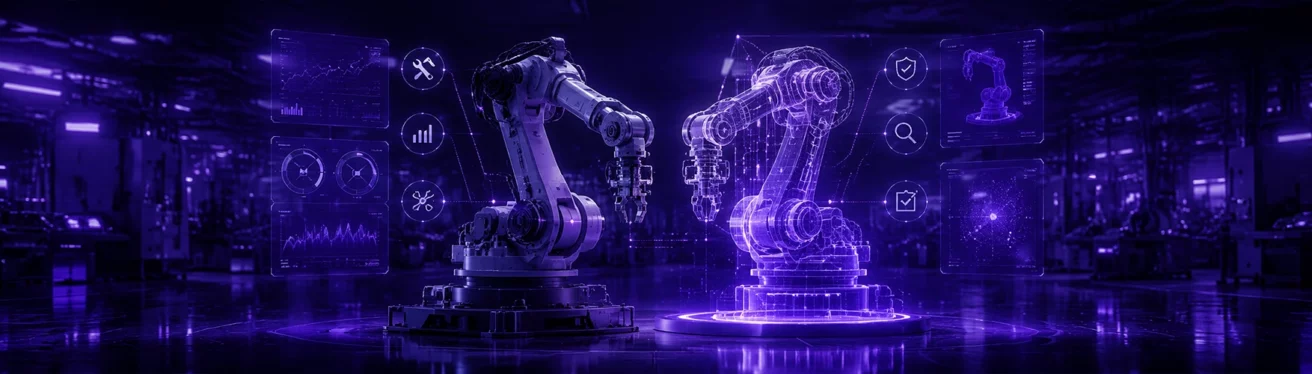
Every industrial conference presents digital twins as the future of manufacturing. Yet, on the shop floor, very few facilities actually operate a fully mature model. Why is there such a gap between ambition and reality? A few years ago, the technology was hyped as a magic bullet to eliminate downtime overnight but once the excitement settled, a practical question emerged:
where do we begin? Modeling an entire plant isn’t just about software. It requires reliable data, integrated systems, and skilled teams. Without these foundations, even the most advanced platform becomes just an expensive dashboard.
The true value of a digital twin lies in solving specific operational problems.
Successful companies don’t build the biggest models; they build the smartest ones. Instead of mapping everything from day one, they target a specific bottleneck, a critical asset, or an energy-intensive process.
This shift changes everything: the goal is no longer technology for its own sake, but driving operational improvement. This article cuts through the marketing hype to deliver a practical roadmap for meaningful ROI, helping you avoid the trap of overly ambitious transformation projects.
30–50% less unplanned downtime
Manufacturers that combine digital twins with predictive maintenance can reduce unplanned downtime by 30 to 50% while improving productivity by up to 30%. The greatest value comes from targeted implementations that solve specific operational challenges rather than enterprise-wide deployments. Source: McKinsey & Company
Digital twins are becoming a strategic priority
By 2027, more than 40% of large industrial organizations are expected to use a combination of digital twins and AI to optimize operational performance and accelerate decision-making. Source: Gartner
Simulation reduces operational risk
Digital twins enable manufacturers to test production changes, process improvements, and maintenance strategies in a virtual environment before applying them on the factory floor, reducing risk, downtime, and implementation costs. Source: Deloitte Insights
What an industrial digital twin actually is
Before discussing value, it’s worth answering a surprisingly simple question: what exactly is a digital twin? The term is often used so broadly that it loses its meaning. Cutting through the buzzword makes every subsequent investment decision much easier.
A simple definition
At its core, an industrial digital twin is a dynamic virtual representation of a physical asset, manufacturing process, production line, or even an entire facility.
Unlike a static digital model, it continuously receives real-world operational data.
Sensors installed on equipment feed information into the model in real time. Machine temperatures, vibration levels, production rates, energy consumption, throughput, maintenance history and environmental conditions can all update continuously.
The result isn’t simply a digital copy it’s a living model that evolves alongside the physical operation.
Imagine looking into a mirror that doesn’t just reflect your appearance. It also shows your heartbeat, predicts your level of fatigue tomorrow and suggests how changing today’s routine could improve your performance next week.
- That’s much closer to what a digital twin does it transforms operational data into actionable insight.
Digital twin vs. simulation vs. 3D models
This distinction often creates confusion, many organizations already use simulation software or CAD models and assume they’re working with digital twins.
They’re not necessarily the same thing.
- A 3D model primarily represents geometry it helps visualize equipment but doesn’t understand what’s happening inside it.
- A simulation predicts outcomes under predefined assumptions. Engineers can model production changes or evaluate hypothetical scenarios, but simulations generally rely on static inputs.
- A digital twin manufacturing environment goes several steps further because it’s connected to live operational data, it continuously reflects the current state of physical assets. As production conditions evolve, the digital model evolves too.
That continuous synchronization enables ongoing optimization instead of one-time analysis.
It’s the difference between looking at yesterday’s weather forecast and watching a live weather radar.
One tells you what might happen the other helps you react as conditions change.
The three levels of digital twins
Not every organization needs a digital twin for an entire factory.
In fact, beginning with a smaller scope often delivers better results most implementations fall into three categories.
Asset twin
This is the simplest and often the most valuable starting point.
An individual machine, compressor, turbine, robotic arm, or production asset is monitored in real time.
Manufacturers commonly use these twins for predictive maintenance and equipment performance optimization.
Process twin
Rather than focusing on a single machine, a process twin models an entire production workflow it helps organizations understand how different assets interact and how small operational changes influence productivity, quality or resource utilization.
These implementations are particularly useful when manufacturers need to improve throughput without major capital investment.
System or plant twin
At the highest level sits the complete plant twin.
Here, multiple production systems, logistics flows, utilities, energy infrastructure and operational processes become interconnected.
While this approach offers tremendous analytical potential, it also represents the highest level of complexity it demands mature data governance, extensive integration between ERP, MES, SCADA, PLCs, IoT platforms and analytics tools, along with strong cross-functional collaboration.
For many organizations, reaching this level isn’t the first objective… it’s the long-term destination and perhaps that’s the most important lesson surrounding digital twins industrial operations.
Success rarely begins with building everything it begins by identifying one operational challenge that genuinely matters, solving it exceptionally well and allowing that success to justify the next step.
Why the hype outpaced reality
Many organizations discovered that implementing an industrial digital twin wasn’t simply about purchasing software. Instead, it required something much more difficult to build: a reliable digital foundation.
When expectations become too big
One of the biggest obstacles wasn’t technology it was expectation.
Manufacturers often approached digital twins as massive transformation projects. Rather than solving one operational challenge, they attempted to replicate entire facilities from the start.
The result? Projects became increasingly complex before they generated any measurable business value.
- Engineering teams struggled with integration.
- IT departments faced unexpected infrastructure requirements.
- Operations teams questioned whether the additional complexity justified the effort.
Eventually, enthusiasm faded, budgets tightened, and pilots quietly stalled.
Ironically, digital twins themselves weren’t the problem.
The scope was organizations that tried to solve everything at once frequently ended up solving very little.
The hidden challenge: data
Here’s a simple question… How can a digital twin accurately represent reality if the data feeding it isn’t reliable?
It can’t; an industrial digital twin is only as good as the information it receives. Unfortunately, many manufacturing environments still rely on fragmented systems developed over decades.
- Production data may live inside MES platforms.
- Maintenance records often remain inside CMMS applications.
- Energy information comes from another platform.
- ERP systems contain operational planning data.
Machine sensors generate continuous streams of information through PLCs and SCADA systems.
None of these systems were necessarily designed to communicate seamlessly.
Creating that interoperability is frequently the most demanding and underestimated part of any digital twin manufacturing initiative.
Without clean, consistent, real-time data, the virtual model gradually loses credibility. Once operators stop trusting the insights, adoption declines… and the digital twin becomes little more than an expensive visualization tool.
Technology alone doesn't create transformation
Another misconception deserves attention some organizations expect a digital twin to improve operations automatically.
In reality, technology doesn’t optimize factories people do.
The digital twin simply provides better visibility, richer simulations and faster decision support.
Engineers still need to interpret recommendations, maintenance teams still prioritize interventions, operations managers still make strategic decisions.
Think of a digital twin as an experienced co-pilot rather than an autopilot.
It provides remarkable guidance, but it doesn’t replace operational expertise.
Organizations that understand this distinction tend to achieve far stronger results because they treat the technology as an operational enabler instead of a magic solution.
High-impact digital twin use cases that deliver ROI
The good news? Manufacturers don’t need a virtual copy of an entire facility to generate measurable business value.
Some of the strongest results come from focused initiatives targeting one operational challenge at a time. These practical digital twin use cases consistently demonstrate tangible returns while reducing implementation risk.
When discussing digital twin ROI, it’s tempting to think in abstract terms.
- Innovation, transformation, industry 4.0.
But executives rarely approve projects because they’re innovative.
They approve projects because they reduce costs, increase efficiency, improve reliability, or lower operational risk.
That’s precisely where targeted digital twin use cases shine.
Predictive maintenance
This is arguably the most mature and widely adopted application.
Instead of following fixed maintenance schedules, manufacturers create digital twins for critical assets such as pumps, compressors, turbines, CNC machines, or robotic systems.
The twin continuously analyzes operational behavior using sensor data, historical performance, maintenance records, vibration, temperature, pressure and runtime.
Gradually, patterns begin to emerge the model recognizes subtle deviations that human operators may never notice.
Perhaps a bearing is degrading; a motor consumes slightly more energy than usual, a vibration pattern slowly shifts over several weeks.
None of these changes may trigger an immediate alarm individually… together, however, they often signal an approaching failure.
Maintenance teams can intervene before unplanned downtime occurs, the benefits extend far beyond repair costs, production schedules become more reliable, spare parts inventories become easier to manage, emergency maintenance decreases, equipment lifespan increases.
- This is one of the clearest examples of measurable digital twin ROI because every avoided shutdown represents tangible financial savings.
Production process optimization
Sometimes the issue isn’t the machine it’s the process surrounding it.
A digital twin manufacturing model can simulate entire production workflows before physical changes are implemented.
What happens if conveyor speeds increase by 10%?
Would relocating a workstation reduce idle time?
Could production sequences be adjusted to improve throughput?
Instead of experimenting directly on the factory floor with all the associated risks engineers test different scenarios inside the virtual environment.
Some ideas fail immediately others reveal surprisingly effective improvements.
Either way, production continues uninterrupted, that ability to experiment safely often accelerates continuous improvement initiatives while reducing operational disruption.
Energy consumption optimization
Energy has become one of manufacturing’s largest operating expenses, reducing consumption isn’t simply an environmental objective anymore it’s a financial priority.
Digital twins help organizations understand where energy is consumed, when demand peaks occur, and how different operational decisions influence overall efficiency.
Rather than relying on monthly utility reports, facilities gain continuous visibility into equipment performance.
They may discover that certain machines consume excessive power during idle periods, compressed air systems may leak unnoticed, HVAC equipment may operate inefficiently outside production hours.
Small adjustments identified through continuous simulation can generate substantial annual savings for energy-intensive industries, these improvements alone may justify the investment.
Product and process validation
Launching a new product often introduces uncertainty.
Will existing equipment handle the new specifications? Will production speed decrease? Will quality remain consistent?
Rather than discovering these issues after production begins, digital twins allow engineering teams to simulate product introductions beforehand.
Manufacturers can evaluate tooling adjustments, production parameters, workflow modifications, and equipment utilization before disrupting operations.
The result is shorter validation cycles, lower development costs and fewer production surprises.
Perhaps most importantly… Innovation becomes less risky.
Training and workforce development
Not every digital twin focuses on machines some focus on people. Training operators inside live production environments can be expensive and occasionally dangerous.
Digital twins create realistic virtual environments where employees can learn procedures, troubleshoot equipment and respond to abnormal situations without affecting production.
New operators build confidence faster.
Experienced technicians practice complex interventions.
Safety improves because critical situations can be rehearsed repeatedly before they occur in real life.
As industrial workforces continue evolving, this application is becoming increasingly valuable.
Knowledge transfer becomes more efficient, especially as experienced employees retire and new talent enters the workforce.
Across all these digital twin use cases, one pattern consistently emerges. The organizations achieving the strongest returns rarely begin with the biggest ambitions.
Instead, they identify one operational pain point… Solve it exceptionally well… Measure the results… and then expand from there.
That disciplined approach often generates far greater digital twin ROI than attempting to virtualize an entire operation from day one.
What digital twins need to succeed
Technology is only one piece of the puzzle. The real differentiator isn’t the software itself it’s the ecosystem that supports it. Organizations that achieve long-term success with digital twins rarely rely on technology alone; they build the right foundations first.
Reliable, real-time data is the foundation
Imagine trying to navigate with a GPS that only updates every twenty minutes. Technically, it still works but would you trust it?
The same principle applies to an industrial digital twin.
Its value depends entirely on the quality of the information flowing into it. That means collecting accurate, real-time data from sensors, connected equipment, historians, and operational systems. If data is incomplete, delayed, or inconsistent, the twin gradually loses its ability to represent reality.
Before launching a digital twin initiative, manufacturers should ask themselves a few simple questions:
- Are our critical assets already connected?
- Can we access reliable production data in real time?
- Do we trust the quality of the information we’re collecting?
- Are key performance indicators consistent across departments?
If the answer to several of these questions is “not yet,” that’s not necessarily a reason to abandon the project. It simply means the priority should be strengthening the data foundation first.
Integration across existing systems
- Manufacturing environments rarely operate with a single software platform.
- Production data may come from SCADA systems.
- Maintenance teams rely on CMMS software.
- Planning happens inside ERP systems.
- Manufacturing execution depends on MES platforms.
Quality information lives somewhere else. An effective digital twin manufacturing environment connects these sources instead of replacing them.
Rather than becoming another isolated application, the digital twin acts as a layer that brings operational information together into a single, contextual view.
The better the integration, the more valuable the insights become.
Start small, really small
Perhaps the biggest lesson learned across industrial digital transformation projects is this: Start smaller than you think.
It’s tempting to build an ambitious roadmap covering every production line and every facility. But complexity grows exponentially as scope increases.
Instead, identify one high-value asset or one clearly defined operational challenge.
Maybe it’s a bottleneck production line a compressor responsible for frequent downtime an energy-intensive process a packaging cell with recurring quality issues.
Solve one problem exceptionally well measure the results, build confidence across the organization.
Then expand.
This incremental approach reduces implementation risk while generating measurable wins that encourage broader adoption.
People matter more than platforms
Technology can produce recommendations, people create improvements.
A successful digital twin initiative requires collaboration between operations, engineering, maintenance, IT and leadership. Each team contributes a different perspective, helping ensure that the model reflects operational reality rather than theoretical assumptions.
Equally important is building internal capability. Organizations don’t need every employee to become a data scientist, but they do need people who understand how to interpret insights, validate recommendations and continuously improve the model over time.
Digital twins should evolve alongside the business not remain static after deployment.
Digital twin vs. other digital transformation investments
Not every operational challenge requires a digital twin. Sometimes, simpler technologies deliver faster results with lower investment. Knowing where digital twins fit within the broader transformation journey is just as important as understanding how they work.
One of the most common questions industrial leaders ask is: “Do we actually need a digital twin?”
The honest answer? Not always.
If a manufacturer simply wants to monitor machine performance, a condition monitoring platform may be sufficient.
If the objective is to automate maintenance scheduling, predictive maintenance software could solve the problem without creating a complete digital twin.
Likewise, if production data remains disconnected across departments, investing first in data integration may generate greater value than implementing advanced simulation models.
A digital twin becomes particularly valuable when organizations need to understand interactions not just individual assets.
When decisions affect multiple systems simultaneously…
When engineers need to test scenarios before implementing physical changes…
When operational complexity makes experimentation expensive…
That’s where digital twins truly stand apart. Rather than replacing existing digital transformation initiatives, they often build upon them.
In many cases, the smartest investment isn’t immediately deploying a digital twin it’s conducting an operational readiness assessment first.
Understanding current infrastructure, data maturity, integration capabilities, and business priorities allows organizations to determine whether a digital twin is the right next step or whether foundational improvements should come first.
That approach significantly reduces project risk while maximizing long-term digital twin ROI.
Building the business case internally
Even the most promising technology needs executive buy-in. The strongest business cases focus less on innovation and more on measurable operational outcomes that resonate with engineering, finance, and executive leadership alike.
Convincing leadership to invest in digital twins isn’t about presenting the most advanced technology.
It’s about answering one fundamental question:”How will this improve our business?”
For operations leaders, the conversation may center on reducing downtime, improving throughput, or increasing production reliability.
For engineering teams, it’s about testing improvements without disrupting production.
For finance departments, the focus shifts to cost avoidance, reduced maintenance expenses, improved asset utilization, and faster return on investment.
Although each stakeholder has different priorities, they all care about measurable business value.
That’s why successful organizations rarely begin with a multi-million-dollar transformation initiative.
Instead, they launch a focused pilot with clearly defined objectives and measurable KPIs, Perhaps the goal is to reduce downtime by 15%.
Improve Overall Equipment Effectiveness (OEE), lower energy consumption or shorten product validation cycles.
Once those outcomes are demonstrated, expanding the initiative becomes a much easier conversation.
Results speak louder than roadmaps.
Conclusion
Digital twins have earned their place among the most influential technologies shaping modern manufacturing but they’re also among the most misunderstood.
For years, the conversation focused on grand visions of fully virtualized factories. While those ambitions remain exciting, they can distract organizations from where the real value lies.
The most successful digital twins industrial operations initiatives aren’t the largest.
They’re the ones that solve meaningful business problems.
Whether improving predictive maintenance, optimizing production processes, reducing energy consumption, validating new manufacturing strategies, or accelerating workforce training, a well-designed industrial digital twin becomes a practical decision-support tool rather than a technological showcase.
Perhaps the biggest takeaway is this: Digital transformation isn’t about implementing the most advanced technology available.
It’s about implementing the right technology at the right time.
Before investing in any digital twin initiative, manufacturers should evaluate their operational maturity, data quality, integration capabilities, and business priorities. Starting with a focused pilot, measuring outcomes, and scaling based on proven value remains the most reliable path toward sustainable digital twin ROI.
Organizations that embrace this pragmatic approach won’t just adopt digital twins they’ll turn them into a lasting competitive advantage.
Commonly asked questions FAQ
1.Is your organization actually ready for a digital twin?
Check your data foundation first. If you don’t already have connected equipment and clean, real-time data flowing between systems like your ERP, MES, or SCADA, a digital twin won’t fix that for you. Most companies start with a quick audit to map out gaps before committing any real budget.
2.What's the smartest way to launch a project?
Start small and targeted. Instead of trying to mirror an entire factory on day one, pick one critical asset, a single bottleneck, or a line with recurring issues. Solving a focused problem proves ROI fast, minimizes risk, and makes getting executive buy-in for scaling much easier.
3.Which industries gain the most value?
It shines anywhere equipment failure or process delay costs real money think manufacturing, automotive, aerospace, energy, pharma, and food processing. If you manage high-value assets or continuous production lines, even a tiny drop in downtime pays off immediately.
4.What tangible results can you expect?
Fewer unexpected breakdowns, better asset reliability, lower energy bills, and sharper operational decisions. The biggest returns always come from fixing concrete, day-to-day pain points rather than chasing a broad, abstract transformation.
These topics might interest you


Agile digitalization: modernizing industrial operations without starting from scratch
Workflow Automation: What It Is & How to Start [Guide]
How compliance management software reduces risk
Newsletter
Subscribe to our newsletter for the latest digital insights, tips, and news.