



The modern industrial landscape feels a bit like trying to solve a Rubik’s Cube while riding a roller coaster. Just as you think you’ve aligned the colors your lead times are stable, your inventory is lean the track loops. A geopolitical flare-up here, a sudden raw material shortage there and suddenly, your “optimized” plan is worth about as much as a screen door on a submarine.
For decades, we relied on spreadsheets and “gut feelings” honed over years on the factory floor. But let’s be honest… that doesn’t scale anymore. The sheer volume of moving parts in industrial supply chain optimization has outpaced the human brain’s ability to process it in real-time. We are drowning in data but starving for insights.
Industrial companies now manage 5–10× more operational data than they did a decade ago, largely driven by IoT, automation and connected logistics. Yet only 20–30% of industrial supply chain data is actually used for decision-making, despite massive investments in ERP and MES systems. We have ERPs, MES systems and CRMs, yet we still find ourselves asking: Why is that shipment late? Why do we have six months of stock for a product no one is buying? The shift to data-driven supply chain management isn’t just a “nice-to-have” digital upgrade; it’s a survival mechanism. It’s about moving from a reactive “firefighting” mode to a proactive, strategic stance where you see the fire before the first spark even lands.
Industrial supply chains under data pressure
More and more industrial players are realizing that their supply chains generate far more data than they actually exploit. 73% of manufacturers say data silos are a major barrier to supply chain visibility and performance. The ability to transform raw data flows into actionable decisions is becoming a key driver of operational performance and competitive advantage.
From operational data to strategic intelligence
Industrial companies are looking to move beyond simple data collection to build a coherent, cross-functional view of their operations. Organizations using advanced supply chain analytics are 2.5× more likely to outperform peers on operational KPIs such as service level and cost efficiency. Yet less than 25% of industrial firms say their supply chain analytics directly influence executive-level strategic decisions. The challenge is no longer just to analyze the past, but to equip strategic decision-making at every level of the organization. Companies with cross-functional data visibility reduce decision latency by 30–50% compared to siloed organizations.
Analytics as a foundation for resilient operations
In the face of market uncertainty and supply volatility, advanced analytics is emerging as a cornerstone of resilience. 75% of supply chain leaders experienced significant disruptions in the last 3 years, yet only 21% felt well prepared to respond. Advanced analytics enables companies to reduce disruption recovery time by up to 40%, and scenario modeling and simulation improve supply chain continuity outcomes by 2–3× during major disruption events. It enables organizations to anticipate disruptions, evaluate alternative scenarios and continuously adjust decisions in real time.
Toward integrated, end-to-end data architectures
The convergence of data from production, logistics and external partners is becoming a strategic priority. Organizations are evolving toward unified architectures capable of supporting both operational excellence and analytical innovation.
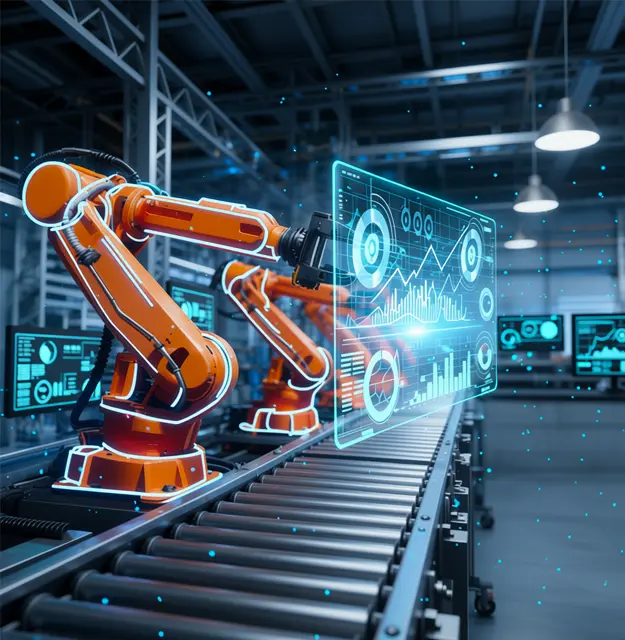
Why industrial supply chains need advanced analytics today
In an era of razor-thin margins and instant disruption, relying on yesterday’s data to make tomorrow’s decisions is a recipe for obsolescence.
If you’ve spent five minutes in a manufacturing hub lately, you know the pressure is relentless.
Fragmented data is the silent killer. Your logistics team is looking at one set of numbers, production at another and procurement is stuck in a third silo. This fragmentation leads to the “Bullwhip Effect” on steroids where a tiny flicker in consumer demand results in massive, costly swings in raw material orders.
Furthermore, industrial supply chain analytics is the only way to combat the rising cost of complexity. With global regulations tightening around carbon footprints and labor practices, you can’t just “guess” your way to compliance. You need supply chain visibility analytics that reach deep into the tiers of your supplier network.
Without it, you aren’t just flying blind; you’re flying blind in a storm.
What is advanced supply chain analytics?
Analytics isn’t just “reporting” on the past; it’s the bridge between raw industrial noise and actionable intelligence.
Most people confuse “reporting” with “analytics.” Reporting tells you that your warehouse is 90% full. Analytics tells you why it’s full of the wrong stuff and how to fix it.
When we talk about advanced data analytics in supply chain, we are talking about the application of math, statistics and AI to massive datasets to find patterns the human eye would miss.
The 4 levels of supply chain analytics
- Descriptive (What happened?): The rear-view mirror. “We missed 15% of our shipments last month.”
- Diagnostic (Why did it happen?): Digging into the “why.” “We missed shipments because the port strike delayed raw material X.”
- Predictive (What will happen?): This is where predictive supply chain management starts. “Based on current trends, we are likely to run out of material Y in three weeks.”
- Prescriptive (What should we do?): The holy grail. “To avoid the shortage of material Y, the system automatically suggests three alternative suppliers and reroutes the logistics path.”
Newsletter
Subscribe to our newsletter for the latest digital insights, tips, and news.
Key use cases of data analytics in industrial supply chains
Seeing the big picture is great, but the real ROI of analytics lives in the trenches of daily operations.
Demand forecasting & production planning
How many times have your forecasts been “off” by a mile? Traditional models usually just look at historical sales. Supply chain optimization analytics, however, pulls in external signals market volatility, weather patterns, even social sentiment. By leveraging predictive analytics supply chain tools, companies can reduce forecast error by 20% to 50%, ensuring that the production line is always building what the market actually wants.
Inventory optimization & working capital
Inventory is essentially cash sitting on a shelf, gathering dust. In the industrial world, overstocking is a security blanket that costs a fortune.
Through industrial data analytics, you can move toward multi-echelon inventory optimization.
This means you aren’t just looking at one warehouse; you’re looking at the entire network to see where stock can be shifted to maximize capital efficiency without sacrificing service levels.
Logistics & distribution performance
Advanced logistics analytics allows you to go beyond simple “track and trace.” It enables dynamic route optimization that accounts for real-time traffic, fuel costs and driver hours. Have you ever wondered if you’re actually making money on that one distant client? Supply chain performance analytics can break down the “cost-to-serve” at a granular level, revealing which routes are goldmines and which are money pits.
Risk management & supply chain resilience
The “Just-in-Time” model was great until the world broke in 2020. Now, it’s about “Just-in-Case.” Analytics allows for scenario modeling essentially “digital rehearsals” of disasters.
What if a supplier in Taiwan goes offline?
What if the Suez Canal is blocked again?
By running these simulations, you build a resilient chain that can pivot in hours, not weeks.
From data silos to end-to-end supply chain visibility
To see the whole forest, you first have to stop hugging the individual trees; integration is the only path to clarity. The biggest hurdle isn’t the math; it’s the silos. Data lives in different languages across different departments. To achieve true supply chain visibility analytics, you need to build a “Single Source of Truth.” This involves ingesting data from IoT sensors on the factory floor, GPS pings from trucks and API feeds from suppliers.
Building a unified supply chain data model
You can’t optimize what you can’t see. A unified data model acts as the central nervous system of your operation. It ensures that when a machine breaks down on the shop floor (tracked via industrial data analytics), the sales team is immediately notified that their delivery dates might shift. This interoperability is what separates the leaders from the laggards. It’s about moving away from batch processing where you find out something went wrong yesterday to real-time streams where you see it happening now.
KPIs & metrics that matter in analytics-driven supply chains
If you measure the wrong things, you’ll get really good at doing the wrong things.
In a data-driven supply chain management environment, the metrics change. We move past simple “spend” and look at:
- OTIF (On Time In Full): The ultimate measure of customer happiness.
- Inventory turnover: How fast is that cash moving?
- Forecast accuracy: How close was your “guess” to reality?
- Lead time variability: It’s not just about how long it takes, but how consistent it is.
- Cost-to-Serve: The total cost of getting a product from the factory to the customer’s door.
How to implement advanced supply chain analytics successfully
A shiny new tool won’t fix a broken culture; implementation is a human challenge disguised as a technical one.
Technology is only 30% of the equation
You can buy the most expensive prescriptive analytics supply chain software in the world, but if your team doesn’t trust the data, they’ll go right back to their “secret” Excel sheets. Implementation requires a shift in data culture. It requires “data translators” people who understand both the Python code and the grease on the factory floor.
Common pitfalls to avoid
Don’t try to boil the ocean. Many companies fail because they try to implement every level of advanced data analytics in supply chain at once. Start with a specific problem maybe it’s high detention fees in logistics solve it, show the ROI and then scale. Also, beware of “garbage in, garbage out.” If your underlying data is messy, your AI will just give you highly confident wrong answers.
The future of industrial supply chains: Predictive, autonomous, intelligent
We are moving toward a world where the supply chain doesn’t just “respond” to commands, but thinks for itself.
The “Self-Healing Supply Chain” is no longer science fiction. We are entering an era of autonomous planning where AI-assisted decision-making handles the mundane stuff reordering fasteners or rescheduling a late truck leaving humans to handle the high-level strategy.
Digital Twins are becoming the standard. Imagine having a complete digital replica of your entire industrial supply chain optimization model. You can test a price increase, a new warehouse location, or a shift in production schedules in a virtual environment before ever spending a dollar in the real world. The future is predictive, it’s fast and it’s incredibly precise.
Conclusion
In the end, industrial supply chain analytics is about one thing: control. In a world that feels increasingly chaotic, data gives you the lever you need to move the world. It turns your supply chain from a cost center into a competitive weapon.
Are you still waiting for the weekly report to tell you what went wrong? Or are you ready to use predictive analytics supply chain tools to write the future? The choice isn’t just about software; it’s about whether you want to be the one disrupted or the one doing the disrupting. Advanced analytics is no longer about optimization it’s about control, anticipation and strategic resilience.
Newsletter
Subscribe to our newsletter for the latest digital insights, tips, and news.