


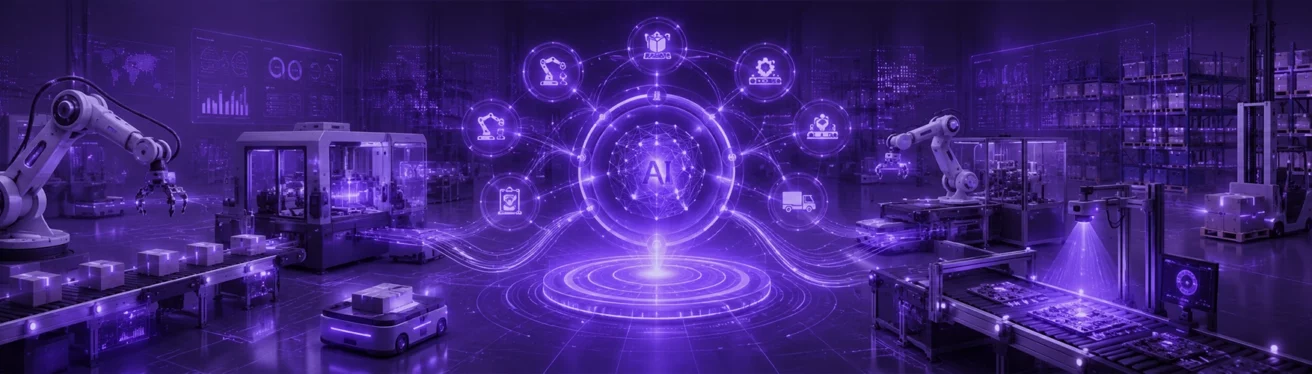
Industrial companies have spent years investing in automation, dashboards, IoT platforms, analytics and AI pilots. Walk into any modern factory floor and you will see screens flashing with real-time analytics, charts tracking overall equipment effectiveness and predictive maintenance alerts waiting for a human eye. These technologies have certainly improved visibility, but let’s be honest for a moment… many operational decisions still depend on manual coordination between teams, systems and sites. When a critical machine throws an error code, a human still has to notice it, log into an ERP, check spare parts, email a supervisor and schedule a technician.
AI agents introduce a massive paradigm shift. Instead of only analyzing data or generating pretty recommendations for a human to sift through, agentic AI can interpret high-level goals, reason across disconnected systems, coordinate complex tasks, trigger automated workflows and support decision-making with an entirely new level of autonomy. For manufacturers, this marks the official beginning of autonomous manufacturing a model where AI in manufacturing does not simply inform work but actively helps orchestrate it.
The transition from copilots to autonomous agents is accelerating
According to Gartner’s Strategic Technology Trends, by 2028, at least 15% of day-to-day enterprise work decisions will be made autonomously through agentic AI, compared to virtually 0% in 2024. In industrial setups, this means the technology is rapidly moving past simple conversational assistants to independent, workflow-executing entities.
The multi-Billion-Dollar impact on industrial productivity
A comprehensive study by McKinsey & Company on the economic potential of generative AI and autonomous workflows estimates that AI technologies could unlock between $2.6 trillion and $4.4 trillion annually across global industries. Manufacturing and supply chain operations stand to capture a massive share of this value, primarily through reduced operational friction and optimized asset utilization.
Slashing unplanned downtime through active orchestration
Data published by the World Economic Forum (WEF) in collaboration with McKinsey on Global Lighthouse Factories reveals that pioneering industrial plants integrating advanced AI and autonomous workflows have achieved up to a 50% reduction in unplanned downtime. They achieve this not just by predicting failures but by letting systems automatically orchestrate the response.

What are AI agents in an industrial context?
Forget everything you know about rigid algorithms and linear logic. Industrial AI agents represent a leap from software that simply obeys rules to software that actually understands intent.
AI agents are goal-driven systems, not simple chatbots
When people hear about AI today, they often think of generative text tools or friendly corporate chatbots that answer basic queries. But industrial AI agents are a different animal. They are dynamic software entities that understand high level objectives, independently access historical data or enterprise tools, plan a logical sequence of actions, execute tasks and continually adapt their strategies based on real time feedback.
Think of them less like static calculators and more like digital teammates who possess a specialized understanding of your plant’s ecosystem. In a modern smart manufacturing environment, an AI agent can execute an impressive, interconnected web of tasks:
- Monitor complex machine performance continuously across thousands of sensory inputs.
- Detect subtle production anomalies that traditional thresholds miss entirely.
- Recommend highly specific maintenance actions based on cross-referenced historical failure data.
- Trigger automated work orders directly into your computerized maintenance management system (CMMS).
- Compare supplier risk scenarios instantly when a supply chain shock occurs.
- Coordinate seamlessly between planning, maintenance, quality, and logistics teams.
- Generate clear, context-aware operational summaries for human shift handovers.
- Escalate critical decisions to human teams with a packaged summary of options when thresholds require it.
How AI agents differ from traditional automation
But wait, haven’t we had factory automation for decades? Yes, but traditional automation follows predefined, rigid rules an unyielding “if-this-then-that” logic. If a temperature hits 90 degrees, sound the alarm.
That is its limit. AI agents in manufacturing are fundamentally more adaptive because they can interpret context, plan multi-step actions across different software environments and interact fluidly with multiple systems at once. It is the difference between a train stuck on a single track and an autonomous vehicle navigating a changing highway.
Dimension | Traditional Automation | AI Agents |
Logic | Rule-based | Goal-driven and context-aware |
Scope | Specific task | Multi-step workflow |
Adaptability | Limited | Learns and adjusts with context |
Interaction | System-to-system | System, data, tool, and human coordination |
Decision support | Predefined outputs | Reasoned recommendations and actions |
Workflow role | Executes instructions | Orchestrates tasks toward an objective |
Why AI agents matter for manufacturing and industrial companies
The hidden tax on industrial productivity isn’t a lack of data; it is the mental fatigue of humans trying to bridge the gaps between siloed enterprise systems.
Industrial operations are full of coordination gaps
Manufacturing performance is rarely limited by a lack of data. Let’s face it, your factory is probably drowning in data.
The true bottleneck is often the time required for human beings to interpret those signals, coordinate cross-functional teams, and act across disconnected IT and OT systems. The reality on the ground is littered with friction-filled scenarios that drag down efficiency every single day:
- A machine anomaly is silently detected by an IoT sensor, but the maintenance team receives the information hours too late because it sat in an unmonitored dashboard.
- A major quality issue appears on the line, but root- cause analysis requires weeks of manual investigation across several mismatched databases.
- A sudden supplier delay severely affects production planning, but the cascading impact is not immediately simulated, leaving the floor producing the wrong goods.
- Energy consumption spikes inexplicably, but corrective action is never assigned automatically because the energy data lives in a separate silo from production logs.
- Operators receive hundreds of generic alerts per shift, causing severe alarm fatigue, meaning they cannot prioritize what truly matters.
AI agents close the gap between insight and execution
The true financial and operational value of industrial AI agents lies in their unique ability to move from passive intelligence to active AI workflow automation. They don’t just sit there waiting for you to ask a question.
They actively probe your systems to answer the core operational stack:
- What is happening?
- Why is it happening?
- What should be done right now?
- Who needs to act immediately? Which system should be updated?
- And crucially, what should be escalated to a human decision-maker?
By handling the heavy lifting of data synthesis and initial system updates, they compress the time-to-resolution from days to seconds.
Autonomous operations do not mean fully human-free factories
Does this mean we are heading toward eerie, dark factories completely devoid of human life? Absolutely not. It is vital to clarify that autonomous operations should never be positioned as a total replacement of human expertise. In high-stakes industrial environments, the only realistic, safe and scalable model is supervised autonomy.
Humans aren’t leaving the factory; their roles are being elevated. Human teams remain absolutely essential for critical decision validation, safety-sensitive processes, complex exception management, strategic prioritization, continuous improvement initiatives and essential ethical and compliance oversight. The agent acts as an amplifier, not a replacement.
Key industrial workflows being reshaped by AI agents
Look closely at your most complex operational headaches from erratic equipment failures to chaotic supplier schedules and you will see the exact workflows where agentic AI excels.
1.Maintenance and asset management
When it comes to keeping an industrial plant running smoothly, predictive maintenance AI agents change the entire playbook. Instead of waiting for a machine to break or mindlessly following a rigid calendar schedule, AI agents can continuously connect condition monitoring streams, historical failure data, spare parts availability, master maintenance schedules and technician workload.
They can detect anomalies before they become smoke, rank assets according to financial and operational risk, propose the most optimal maintenance windows to minimize production impacts and automatically check the availability of spare parts. In case of a missing part, the agent can flag it or generate a purchase request.
- Reduced catastrophic unplanned downtime, optimized maintenance planning schedules, significantly lower emergency repair costs, and drastically improved overall asset availability.
2.Production planning and scheduling
It’s easy for production schedules to fall apart. One broken machine, a late shipment of raw materials, or a sudden change in what customers want can bring the whole thing crashing down. AI agents can help production teams deal with sudden changes in demand, inventory, machine availability, or the number of people working on the project. This means that plans can be changed in real time as needed.
They can quickly go through dozens of different schedule options, find hidden bottlenecks before they stop work, move production orders around to use the best resources and make sure that procurement and logistics are working together to make sure that materials are in line with the new plan.
- More products being made at once. Less expensive mistakes in planning. Responding so quickly to daily problems is amazing. Better use of resources.
3.Quality control and root-cause analysis
When a defect rate ticks upward, quality engineers often turn into detectives, painstakingly digging through piles of historical data. AI agents can support quality teams by instantly combining automated inspection data, real-time machine parameters, batch history, supplier data and even qualitative operator shift notes.
They can automatically detect recurring defect patterns across different production lines, suggest the most probable root causes by analyzing multi-variable correlations, and trigger immediate containment workflows to prevent further waste.
- Substantially lower scrap rates, significantly faster issue resolution times, bulletproof digital traceability and a much better first-pass yield.
4.Supply chain and procurement workflows
Modern supply chains are notoriously volatile. AI agents help industrial companies proactively manage supply risks, material shortages, erratic supplier performance and global logistics disruptions.
By continuously monitoring supplier delays, an agent can instantly compare alternative sourcing options, simulate the precise cascading production impact of a delayed component and automatically prioritize urgent purchase orders to minimize downtime.
- Unmatched supply chain resilience, reduced stockouts of critical components, better data-driven supplier management, and rapid disruption response.
5.Energy and sustainability operations
Energy is no longer a fixed cost of doing business; it is a dynamic variable that affects profitability and regulatory compliance. AI agents continuously monitor energy consumption patterns, production loads, changing utility tariffs and the performance of localized equipment to optimize energy.
They can identify abnormal consumption peaks in real time, suggest fine-tuning of loads (for example, moving energy-intensive processes to off-peak tariff hours) and connect energy performance to specific production contexts.
- Reduced overall utility and energy costs Reduced carbon emissions Seamless automated sustainability reporting Green operational efficiency
6.Customer service and aftermarket operations
For industrial manufacturers that maintain a vast installed base of equipment at customer sites, AI agents act as a powerful extension of the aftermarket service team. They can analyze complex incoming service tickets, cross-reference them with years of technical documentation and recommend highly accurate troubleshooting steps.
- Faster response times for clients, improved customer satisfaction scores, higher recurring service revenue and deep intelligence regarding installed-base failures.
From dashboards to agentic workflows
The industrial world is suffering from dashboard fatigue. We don’t need more screens to look at; we need systems that help us execute the work.
Dashboards show the problem
For the last decade, the holy grail of digital transformation was the dashboard. We built massive control rooms filled with screens showing every imaginable key performance indicator (KPI). But let’s ask a candid question: what happens when a dashboard turns red?
Nothing happens until a human looks at it, analyzes it, decides to act, logs into another system and starts making phone calls. Dashboards provide visibility, yes, but they still rely entirely on human energy to interpret, prioritize, coordinate, and execute. They show the problem, but they don’t move the needle on solving it.
AI agents help manage the workflow
This is where AI operations make their grand entrance. AI agents don’t just display a red bar on a screen; they connect data interpretation with the next-best action, automated workflow execution, and structured human escalation.
They turn passive charts into active execution pipelines. If a KPI drops, the agent doesn’t just sound an alarm; it begins investigating across databases, drafting mitigation strategies, and preparing the exact tools a human needs to fix it.
The future is not more dashboards, but more operational intelligence
Industrial companies should desperately avoid building yet another layer of static reporting that nobody looks at.
The genuine strategic opportunity is to design workflows where AI actively reduces cognitive friction, slashes decision latency, and eliminates coordination effort. We need to shift our focus away from simply collecting data toward automating operational intelligence.
| Stage | Traditional Analytics | AI Agents |
| Data visibility | Dashboard shows static KPIs | Agent monitors KPIs continuously in real time |
| Alerting | Sends generic, noisy notifications | Prioritizes and filters alerts based on context |
| Diagnosis | Human investigates root causes manually | Agent suggests highly probable causes instantly |
| Action | Human coordinates across systems manually | Agent triggers or prepares multi-system workflows |
| Escalation | Informal communication (emails, calls) | Structured, context-rich human approval paths |
| Learning | Periodic, manual post-mortem reviews | Continuous learning via closed feedback loops |
What autonomous operations could look like in practice
To truly understand the power of agentic AI, let’s step away from theory and walk through a few real-world scenarios on a messy, fast-moving factory floor.
Scenario 1: Predictive maintenance agent
Imagine a critical water pump on a main line. Suddenly, an abnormal vibration anomaly appears in the sensory data stream. Instead of triggering a generic alarm that gets ignored, a predictive maintenance agent springs into action. It instantly checks historical failure patterns for that specific pump model, checks the current production schedule to see when the line can safely pause, verifies spare parts availability in the warehouse, and reviews technician schedules.
Within two minutes, it recommends an optimized intervention plan, drafts a detailed work order, and escalates a clean approval package straight to the maintenance manager’s tablet. The manager taps “approve,” and the entire workflow is executed.
Scenario 2: Quality investigation agent
On production line three, the defect rate for a specific component suddenly ticks upward by 4%. An agent specialized in quality investigation immediately begins parsing the data. It analyzes real-time inspection camera images, batch numbers, raw material records from suppliers, machine settings, and previous incident reports.
Within moments, it identifies that the defects are highly correlated with a specific batch of raw materials combined with a slight temperature drift on oven four. It immediately flags the suspicious batch, suggests specific containment actions to the floor supervisor, and drafts a non-conformity report for the procurement team.
Scenario 3: Supply disruption agent
A massive storm delays a container ship carrying critical electronic components. A supply chain agent monitors these global logistics feeds and instantly identifies that the delay threatens production continuity for the upcoming week. It doesn’t panic.
It immediately assesses current safety stock levels, queries pre-approved alternative local suppliers for pricing and lead times, looks at open customer orders, and calculates production constraints. It then presents three distinct mitigation scenarios to the planning team, ranking them by cost and delivery impact, allowing planners to make an informed pivot in minutes.
Scenario 4: Energy optimization agent
During a Tuesday night shift, an energy optimization agent detects an abnormal, uncharacteristic spike in electricity consumption on the main floor. It instantly compares current equipment behavior, production load, local weather conditions, fluctuating tariff periods, and historical output data.
It isolates the cause a cooling system running at maximum capacity due to an open ventilation door and immediately sends a direct, localized alert to the floor team to shut the door, preventing thousands of dollars in wasted energy expenditure.
The risks of autonomous operations
Let’s be completely candid: handing over any level of operational control to an AI system without guardrails is a recipe for operational chaos.
Risk 1: Uncontrolled autonomy
No manufacturer should ever give an AI agent completely unrestricted, blind access to critical physical infrastructure or core financial transactional systems. Imagine an agent autonomously rewriting PLC code or buying millions of dollars of raw materials without a safety check.
Autonomy must be explicitly staged, tightly bounded, and strictly supervised by human experts.
Risk 2: Poor data quality
An AI agent is only as good as the data it feeds on. If your factory floor is plagued by disconnected sensors, mislabeled equipment tags, or delayed ERP entries, the agent will act on bad assumptions.
Garbled, dirty, or uncontextualized data will inevitably lead to unreliable agent behavior and broken workflows.
Risk 3: Lack of explainability
If an AI agent recommends shutting down an entire production line, operators will not follow that advice blindly unless they understand why.
“Black box” AI models create deep distrust on the shop floor. Agents must be built with clear explainability, explicitly showing the data, logic, and reasoning behind every recommendation they put forward.
Risk 4: Cybersecurity exposure
Because AI agents naturally require access to multiple interconnected IT and OT systems to do their jobs effectively, they can inadvertently expand your digital attack surface.
If identity management, role-based permissions, and continuous API monitoring are not properly implemented, a compromised agent could become a gateway for cyber threats.
Risk 5: Workflow misalignment
If AI agents are developed in an isolated tech lab without deep input from real shop- floor operators, they will likely create more operational noise than actual value.
An agent that generates beautifully typed summaries that don’t align with how real humans actually run a shift will quickly be bypassed and abandoned.
Risk 6: Over-automation of critical decisions
High-impact operational domains such as safety-critical processes, environmental compliance releases, and massive capital expenditures must always maintain ironclad human oversight.
Over-automating these sensitive areas creates immense liability and ignores the invaluable tribal knowledge of experienced personnel.
The risks of autonomous operations
You don’t build a self-optimizing factory overnight. It is a deliberate journey of mapping workflows, defining safety boundaries, and laying a rock-solid data foundation.
1.Identify workflows, not isolated tasks
AI agents deliver their highest ROI when they are allowed to operate across multi-step, cross-functional workflows rather than isolated, repetitive tasks.
Look for high-friction processes where data routinely changes hands between different departments.
Excellent priority candidates to target first include:
- Maintenance intervention planning and scheduling.
- Complex quality incident investigation and root-cause analysis.
- Dynamic production rescheduling due to unexpected floor disruptions.
- Supplier disruption management and material reallocation.
- Real-time energy optimization and load shedding.
- Aftermarket service ticket resolution and spare parts planning.
2.Map the decision flow
Before you write a single line of code or deploy a vendor agent, you must explicitly define how decisions are actually made on your floor today.
Take the time to answer these core architectural questions: What specific event triggers the workflow? Which exact data sources are required to understand the situation? Who owns the ultimate decision today? Which enterprise software systems are touched? Where do the longest time bottlenecks occur? Which low-risk actions can be safely automated immediately, and which high-impact actions must require explicit human sign-off?
3.Define autonomy levels
Not every manufacturing workflow should be treated equally. You shouldn’t jump straight to full automation.
Instead, establish a clear, structured framework of autonomy levels across your operations:
- Level 1: Agent observes and summarizes – The agent simply watches data streams and summarizes complex situations for human review.
- Level 2: Agent recommends actions – The agent highlights anomalies and suggests a few potential paths forward.
- Level 3: Agent prepares workflows for approval – The agent drafts the work orders and scripts, waiting for a human to hit “send.”
- Level 4: Agent executes low-risk actions – The agent completely automates non- critical tasks within strict, pre-approved bounds.
- Level 5: Agent autonomously optimizes – The agent completely manages and optimizes a localized system within strict physical boundaries.
4.Build the data and integration foundation
To operate reliably, AI agents require immediate access to high-fidelity, trustworthy operational context.
You cannot build a smart agent on top of a broken data architecture. Your foundational tech stack must feature clean, highly contextualized data streams, a standardized enterprise taxonomy, seamlessly connected IT (ERP/SCADA) and OT (MES/PLC) systems, an API-ready architecture, robust access management protocols, and reliable real-time or near-real-time data flows.
5.Start with supervised autonomy
The golden rule of deploying agentic AI in industrial spaces is simple: crawl, walk, then run. Always begin your deployment journey with strict “human-in-the-loop” workflows.
Let your operators work alongside the agent for several months. This allows the team to build deep trust in the agent’s reasoning, while giving your engineers a safe environment to iron out edge cases and refine boundaries before turning on higher levels of automation.
6.Measure operational value
Don’t get blinded by the hype of AI technology; track its success using pragmatic business and adoption metrics.
If your agents are truly working, you should see measurable shifts in your operational KPIs:
- Time to decision & Time to resolution: How much faster are you solving floor issues?
- Downtime reduction: Are you preventing costly unplanned asset stops?
- Alert reduction: Has the noise level on your operator dashboards gone down?
- Recommendation acceptance rate: Do operators actually trust and use the agent’s advice?
- Manual workload reduction: How many hours of tedious data entry did you eliminate?
AI agent readiness checklist for industrial companies
Before you invest a single dollar in agentic architecture, use this diagnostic framework to determine if your operational foundation is built on rock or sand.
Use this diagnostic checklist to evaluate whether a specific operational workflow within your company is truly ready for an AI agent deployment:
- Workflow Friction: Have we identified a high-friction operational workflow that suffers from clear delays?
- Repetitive Patterns: Is the workflow structured and repetitive enough to benefit from agentic support?
- Data Accessibility: Are the required underlying data sources readily accessible for software tools?
- System Integration: Are modern ERP, MES, CMMS, IoT, or SCADA APIs available for connection?
- Data Trust: Is the incoming data accurate, timely, highly contextualized, and trustworthy?
- Decision Governance: Do we know exactly which decisions can be automated and which require human eyes?
- Autonomy Guardrails: Have we explicitly defined the acceptable autonomy level for this specific use case?
- Cybersecurity & Access: Are cybersecurity protocols, token access rights, and permissions clearly managed?
- Audit Trails: Are comprehensive audit logs and step-by-step traceability active for every agent action?
- User Involvement: Have frontline operators and business owners been involved in the design process?
- ROI Clarity: Do we have a clear financial ROI model tracking time savings, quality improvements, or uptime?
- Scalability Potential: Can this specific agent blueprint be easily scaled to other sites, assets, or sister workflows?
The strategic opportunity: from smart manufacturing to self-optimizing operations
The industry is pivoting from “connected” to “self-optimizing” but achieving this requires more than just adding software; it requires a complete rethink of your operational DNA.
AI agents represent a fundamental, historic transition away from merely connected operations toward true self-optimizing operations. For decades, the industrial maturity path has moved slowly but surely through sequential stages. We started with purely manual operations, progressed to digitized operations with basic software, advanced to connected operations via IoT, and recently experimented with predictive operations using basic machine learning.
Now, we are entering the era of agent-assisted operations, which paves the direct way toward fully autonomous operations. But here is the critical strategic truth: autonomous operations are never achieved by simply throwing a shiny AI agent on top of broken, inefficient legacy processes. It requires a thoughtful willingness to redesign workflows, build deep data readiness, establish clear modern governance, and focus heavily on human adoption.
How Eminence Industry helps industrial companies prepare for agentic AI
Navigating the hype of industrial AI is difficult; our mission is to cut through the noise and turn theoretical autonomy into measurable operational reality.
At Eminence Industry, we know that the leap into autonomous manufacturing can feel daunting. We help industrial companies cut through the market noise to identify exactly where AI agents can create immediate, measurable financial value and how to deploy them safely and responsibly.
Our specialized enterprise approach supports you across every step of your digital transformation journey:
- Industrial workflow audits to pinpoint hidden operational friction points.
- AI agent opportunity mapping tailored specifically to your unique factory floor.
- Data and integration readiness assessments to ensure your IT/OT layer can support agents.
- Pragmatic use case prioritization based on clear financial ROI and technical feasibility.
- End-to-end AI roadmap design and comprehensive governance frameworks.
- UX/UI design for operational interfaces that operators actually enjoy using.
- Dashboard and decision-support redesign to transition from passive screens to active execution.
- Change management and adoption strategies to build trust on the shop floor.
- Robust KPI frameworks to continuously measure and prove operational impact.
Our ultimate goal is never to automate everything just for the sake of using new technology. Our goal is to find those high-leverage workflows where autonomous orchestration can dramatically reduce friction, elevate decision quality and generate massive operational impact for your bottom line.
Conclusion
AI agents will undeniably reshape industrial workflows by moving companies away from passive monitoring toward active, real-time operational orchestration but the industrial companies that stand to benefit the most from this revolution will not be those that frantically deploy agents the fastest simply to chase a tech trend.
The true winners will be the pragmatic organizations that take the time to deliberately redesign their workflows, clean and structure their enterprise data, define clear safety and governance boundaries, deeply involve their frontline operational teams and scale autonomy progressively over time.
In the demanding world of manufacturing, the future of AI is not just about raw computational intelligence… it is entirely about controlled, measurable, and trusted executio
These topics might interest you

How a clear AI strategy drives industrial companies
AI audit and diagnosis: identifying quick wins in digital transformation
Generative AI: industrial use cases beyond the hype
Newsletter
Subscribe to our newsletter for the latest digital insights, tips, and news.